How to Make Your Dog a Service Dog | All You Need To Know

If you already have a dog and wonder whether you can turn your pet into a service dog, the answer can be yes. Under the Americans with Disabilities Act (ADA), a person with a disability may train their own dog, and a professional training program is not required. However, the dog must be individually trained to perform work or tasks directly related to the person’s disability.
Making a pet a service dog is much more than buying a vest or registering the dog online. Your dog needs the right temperament, reliable obedience, disability-related task training, and the ability to remain under control in public. This guide explains how to train a service dog, what the ADA requires, and what you should know about certification, registration, public access, and psychiatric service dogs.
Can I Train My Own Service Dog?
Yes. You can train your own service dog in the United States. The ADA does not require people with disabilities to use a professional service dog training organization. Owner-trained service dogs are permitted under federal ADA rules.
Training your own dog can give you more control over the process and allow you to teach tasks that specifically match your needs. However, it also requires consistency, patience, and a realistic understanding of your dog’s abilities.
You may still benefit from working with a qualified professional trainer, particularly when teaching complex tasks or addressing problems such as fear, reactivity, aggression, or poor public behavior.
What Makes a Dog a Service Dog?
Under the ADA, a service animal is generally a dog that has been individually trained to perform work or tasks for a person with a disability. The task must be directly related to the person’s disability.
For example, a dog might be trained to retrieve medication, alert someone to a sound, provide trained assistance during a seizure, retrieve an item, or interrupt a specific disability-related behavior.
Simply having a dog that makes you feel calmer does not, by itself, make the dog a service animal under the ADA. Emotional support, comfort, companionship, and therapy are different from performing a trained disability-related task.
Does Your Dog Qualify to Become a Service Dog?
Not every pet is a good candidate for service work. Although the ADA does not restrict service dogs to particular breeds or sizes, the individual dog’s behavior and ability to perform the required work are extremely important.
Look at your dog’s:
- Temperament
- Health and physical ability
- Trainability
- Ability to focus
- Reaction to strangers
- Reaction to other dogs
- Comfort around unfamiliar environments
- Ability to ignore distractions
- Ability to remain calm and under control
A dog that regularly barks at strangers, lunges at other animals, panics in crowded places, or cannot settle may have difficulty becoming a reliable service dog.
Being friendly is not enough. A service dog needs to work reliably even when the environment is busy, noisy, unfamiliar, or distracting.
How to Train a Service Dog Step by Step
Training your own service dog is a gradual process. Avoid rushing into public-access work before your dog has developed reliable basic behavior.
Step 1: Identify Your Disability-Related Needs
Start by deciding what you actually need the dog to do.
Think about the situations in which your disability affects your daily life and identify specific actions that a dog could be trained to perform.
Your goal should be a clearly defined task rather than simply wanting the dog nearby for comfort.
Step 2: Choose the Right Service Dog Tasks
Once you understand your needs, choose realistic tasks your dog can learn.
The task should be directly related to your disability. The ADA recognizes many types of work, including retrieving items, alerting to sounds, providing certain forms of assistance, and helping interrupt disability-related behaviors.
Step 3: Teach Basic Obedience
Before advanced service dog training, your dog should have a strong obedience foundation.
Important skills include:
- Sit
- Down
- Stay
- Come
- Leave it
- Loose-leash walking
- Place
- Focus
- Settling quietly
Your dog should respond consistently rather than only when the environment is calm.
Step 4: Build Impulse Control
Impulse control is essential for service work.
Your dog should learn to ignore food on the floor, avoid jumping on people, wait patiently, and remain focused on you despite distractions.
Practice gradually by increasing the difficulty rather than immediately taking your dog into the busiest environment possible.
Step 5: Socialize Your Dog Properly
Service dogs encounter many unusual sights and sounds.
Gradually expose your dog to different environments, including:
- Stores
- Elevators
- Traffic
- Crowds
- Wheelchairs
- Public transportation
- Different flooring
- Loud noises
- Unfamiliar people
Socialization should be controlled and positive. Do not force a fearful dog into situations that overwhelm it.
Step 6: Train Disability-Related Tasks
Now begin teaching the specific tasks your dog needs to perform.
Break each task into small behaviors, reward correct responses, and gradually add a cue. Once the dog understands the behavior, practice it in different places and under increasing levels of distraction.
A task is not truly reliable just because your dog performs it once at home. The goal is consistent performance when the task is genuinely needed.
Step 7: Practice Around Distractions
Service dogs must work around real-world distractions.
Practice around people, noises, food, other dogs, doors, vehicles, and unfamiliar environments.
Increase difficulty slowly. If your dog stops responding reliably, make the exercise easier and build back up.
Step 8: Develop Reliable Public Behavior
A service dog needs to remain under control in public. The ADA requires service animals to be under the handler’s control, with limited exceptions when a leash or tether would interfere with the dog’s work or the person’s disability.
Your dog should be able to walk calmly, settle quietly, ignore distractions, and avoid inappropriate interaction with people or animals.
What Tasks Can a Service Dog Perform?
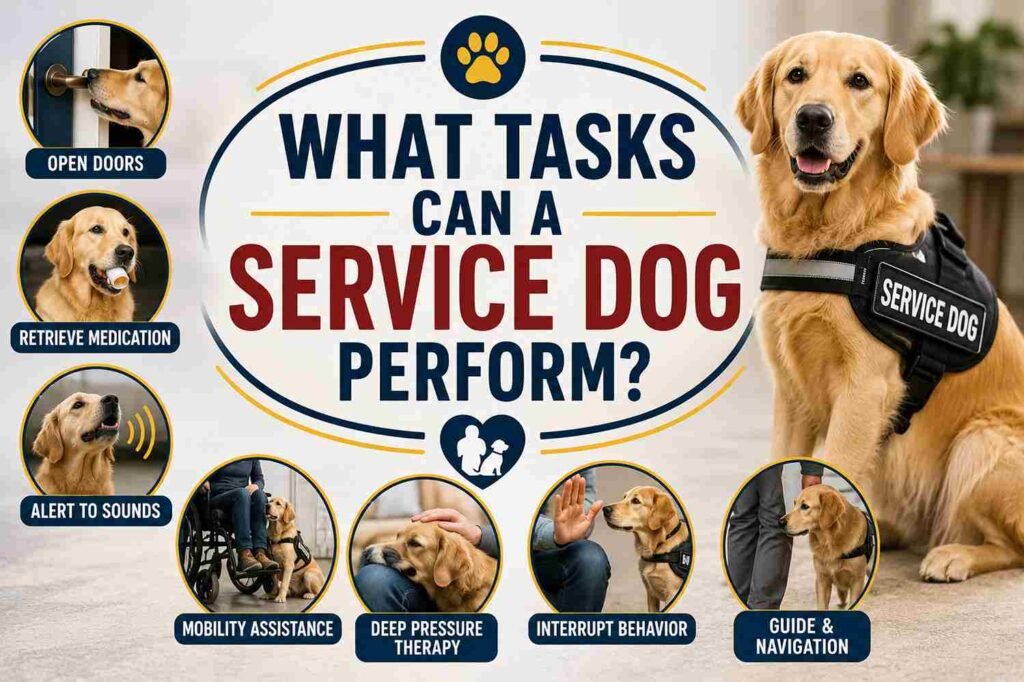
A service dog tasks list can include many different types of disability-related work.
Examples include:
- Retrieving medication or other necessary items
- Alerting a person to specific sounds
- Providing trained assistance during a seizure
- Retrieving a telephone
- Helping with certain mobility-related activities
- Interrupting specific destructive or impulsive behaviors
- Performing trained psychiatric responses
- Alerting to particular medical conditions when appropriately trained
The ADA specifically recognizes tasks related to physical, sensory, psychiatric, intellectual, and other mental disabilities.
The important point is not the name of the task but its relationship to the person’s disability.
Psychiatric Service Dog Training and Requirements
A psychiatric service dog is trained to perform specific tasks for a person with a psychiatric disability.
Psychiatric service dog training may involve tasks such as interrupting a disability-related behavior, retrieving medication, guiding the handler away from a triggering situation, or performing another trained action that assists with the person’s disability.
A dog that simply provides comfort by being present is not automatically a psychiatric service dog under the ADA. However, if the dog is trained to recognize a situation and perform a specific action that helps with the person’s disability, it may qualify as a service animal.
Do You Need a Psychiatric Service Dog Letter?
The ADA does not generally require a person to carry a psychiatric service dog letter or medical certificate to prove the dog is a service animal when accessing covered public places.
If the need for the dog is not obvious, staff may generally ask only whether the dog is required because of a disability and what work or task the dog has been trained to perform. They cannot require documentation as a condition of entry under the ADA.
Other laws and situations, such as housing, can involve different rules, so do not assume that ADA public-access rules answer every service-animal question.
How to Get a Service Dog
There are several ways to get a service dog.
You can:
- Train an existing dog yourself.
- Work with a professional trainer.
- Apply to an organization that trains and places service dogs.
If you already have a suitable dog, an owner-trained service dog may be an option. But if your dog has serious behavioral or health problems, getting a professionally trained dog or choosing another candidate may be more practical.
Can You Make Your Pet a Service Dog?
Yes, a pet can potentially become a service dog if the dog is suitable for the work and is trained to perform disability-related tasks.
However, simply deciding that your pet is now a service dog does not provide the dog with service-animal status.
Your dog needs appropriate training and must be able to perform the required work or tasks. Public behavior also matters because service animals are expected to remain under control.
Do Service Dogs Need Certification?
No. The ADA does not require service dogs to be certified.
There is also no federal requirement to obtain an online service dog certificate before your dog can qualify under the ADA.
The Department of Justice states that businesses cannot require certification, registration, licensing, or other documentation as a condition of entry under the ADA. Online certificates and registration documents do not create ADA rights.
This is why paying a website to “certify” your dog does not turn an untrained pet into a service dog.
Do You Need to Register a Service Dog?
No federal ADA registration is required.
Some cities and states require ordinary dog licensing or vaccination, and those rules can still apply to service dogs. Local governments may also offer voluntary service-animal registries, but mandatory service-dog registration as a condition of ADA public access is not permitted.
So if you search for “how to register a service dog,” be careful with websites claiming that their registration is federally required.
What Are the ADA Service Dog Standards?
The ADA does not create a federal certification test or formal training certificate for service dogs. Instead, the key standard is that the dog is individually trained to perform work or tasks directly related to the person’s disability.
The dog should also remain under the handler’s control.
Businesses and state or local government facilities generally cannot require a service dog to wear a vest, show certification, or demonstrate its task. When the service role is not obvious, staff may generally ask the two permitted questions described by the ADA.
Service Dog Public Access Training
Good public-access behavior is one of the most important parts of training.
Practice:
- Walking calmly on a leash
- Ignoring strangers
- Ignoring other animals
- Ignoring dropped food
- Settling quietly
- Staying close to the handler
- Responding to cues
- Remaining calm around crowds
- Appropriate toileting
There is no single federal ADA “service dog public access test” that every owner must pass to receive certification. The ADA does not require a professional training program or certification process.
However, responsible handlers should honestly evaluate whether their dog can behave appropriately in public.
How Long Does Service Dog Training Take?
There is no universal training timeline.
The amount of time depends on your dog’s age, temperament, previous obedience, task complexity, health, training frequency, and ability to work around distractions.
Basic obedience may develop relatively quickly, but reliable task performance and public behavior can take much longer.
Do not rush the process simply because you want to start taking your dog everywhere. Training should progress according to the dog’s actual reliability.
How Much Does It Cost to Train a Service Dog?
Training your own dog can reduce some professional training costs, but it is not necessarily free.
Possible expenses include:
- Veterinary care
- Vaccinations
- Food
- Leashes and harnesses
- Training equipment
- Obedience classes
- Professional training sessions
- Task-training assistance
- Transportation
- Grooming and routine care
The cost can vary significantly depending on how much training you handle yourself and whether your dog needs professional help.
Service Dog vs Emotional Support Animal
A service dog and an emotional support animal are not the same.
A service dog is individually trained to perform work or tasks directly related to a person’s disability. An emotional support animal primarily provides comfort or emotional support and does not receive the same service-animal status under the ADA.
Understanding this difference is important before deciding whether service-dog training is appropriate for your situation.
Common Service Dog Training Mistakes
Avoid these common mistakes:
- Choosing a dog based only on breed
- Ignoring poor temperament
- Rushing public-access training
- Skipping basic obedience
- Confusing comfort with a trained task
- Buying an unnecessary online certificate
- Assuming a vest proves service-dog status
- Ignoring reactivity
- Failing to practice around distractions
- Expecting a dog to become reliable overnight
Professional guidance can be especially valuable when your dog struggles with behavior or when the required task is complex.
Frequently Asked Questions
Can I train my own service dog?
Yes. The ADA allows a person with a disability to train their own service dog and does not require a professional training program.
How do I make my pet a service dog?
Your pet must be suitable for the work, trained to perform disability-related tasks, and able to remain under control. A vest or registration does not create service-dog status.
Do service dogs need a certificate?
No. The ADA does not require service dogs to have a certificate or certification.
How do I register a service dog?
There is no federal ADA registration requirement. Local dog licensing and vaccination rules can still apply.
What are psychiatric service dog requirements?
A psychiatric service dog must be trained to perform work or tasks directly related to a person’s disability. Comfort from the dog’s presence alone is not enough under the ADA.
Can any breed become a service dog?
The ADA does not restrict service dogs by breed or size. However, the individual dog’s temperament, health, behavior, and ability to perform the necessary work still matter.
Final Takeaway
Learning how to make your dog a service dog takes time, consistency, and careful training. You can train your own service dog, but your pet must be capable of performing specific disability-related tasks and behaving reliably in public.
Most importantly, remember that a service dog does not become a service dog because of a certificate, registration, vest, or online ID card. Under the ADA, the focus is on the dog’s trained work or tasks, its relationship to the handler’s disability, and appropriate control.
If your dog is a good candidate, start with obedience and impulse control, gradually teach the required tasks, and build reliable behavior in increasingly challenging environments. When needed, seek help from a qualified trainer rather than rushing your dog into situations it is not ready to handle.