Why Wont My Dog Let Me Walk It Properly | Top 7 Reasons

Dogs may refuse to walk properly because of pain, injury, fear, anxiety, uncomfortable gear, fatigue, or insufficient leash training. Check for physical discomfort, use comfortable equipment, and reward calm movement with treats. Never drag or force your dog, as this can increase stress and resistance.
In this article, discover why your dog refuses to walk properly, what may be causing the behavior, and simple ways to make walks easier and stress-free.
Why Does My Dog Refuse to Walk on a Leash?
A dog may refuse to walk on a leash because something about the experience makes it uncomfortable, frightening, confusing, or physically difficult. This is especially common in puppies that are still learning what a leash and harness mean.
Some dogs become nervous around traffic, bicycles, strangers, barking dogs, or unfamiliar sounds. Others may dislike the pressure from a collar or harness. A dog that has not learned loose-leash walking may also stop frequently because it does not yet understand what you expect.
Pain should not be overlooked, particularly if the behavior begins suddenly. Paw injuries, sore nails, joint problems, muscle pain, or other health issues can make walking uncomfortable.
The best approach is to look at the situation as communication rather than disobedience. Your dog is showing you that something is making it difficult to continue.
Why Does My Dog Stop Walking and Won’t Move?
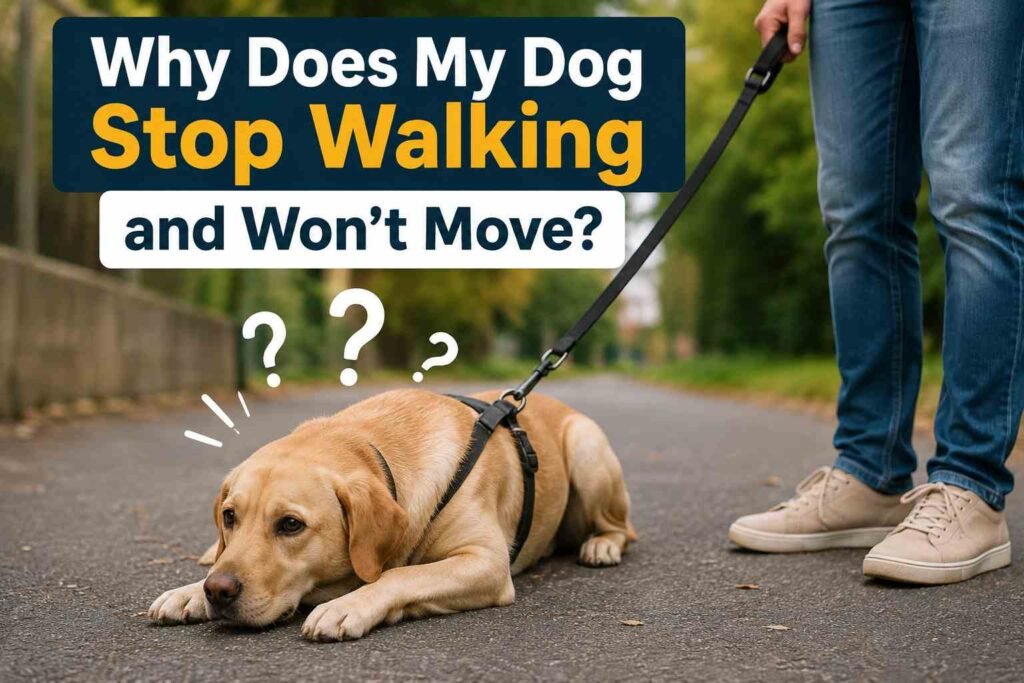
When a dog stops walking and won’t move, pay attention to what happens immediately before the stop. If your dog notices a loud truck, another dog, a stranger, or an unfamiliar object and then freezes, fear or uncertainty may be involved.
Some dogs simply become distracted by an interesting smell or sound. They may stop and look around because they are taking in information from their surroundings. Dogs experience the world heavily through their noses, so a short pause is not necessarily a problem.
However, repeated stopping can also indicate discomfort or poor leash skills. If your dog suddenly stops walking after previously enjoying walks, consider whether something has changed. A new route, different harness, hot pavement, injury, or frightening experience may be responsible.
Trying to drag the dog forward can make the situation worse. Instead, remain calm and determine what caused the hesitation.
Why Does My Dog Plant Its Feet on Walks?
The dog plants feet on walk behavior is one of the most obvious ways a dog can refuse to continue. It may stand firmly in one place while you gently encourage it to move.
This can happen when a dog feels nervous about where you are going. For example, your dog may be comfortable walking around the neighborhood but suddenly stop near a busy road. It may also happen when the dog sees something it does not understand.
Some dogs plant their feet because they dislike leash pressure. Others have learned that stopping gets them attention, treats, a change of direction, or a trip back home.
Rather than pulling harder, try to identify the reason. If the dog looks frightened, give it more distance from whatever is causing the concern. If it appears relaxed and simply distracted, calmly redirect its attention and reward it when it begins walking again.
Why Does My Dog Freeze or Lie Down on Walks?
Why Does My Dog Freeze on Walks?
When you ask, “Why does my dog freeze on walks?” the answer often involves fear, uncertainty, or overstimulation. A frozen dog may become very still, lower its body, avoid eye contact, tuck its tail, or stare at something nearby.
The trigger might be obvious, such as fireworks or a barking dog, but sometimes it is difficult for an owner to notice. A particular surface, smell, sound, or location may make the dog uncomfortable.
Freezing should not automatically be treated as stubborn behavior. A frightened dog may be unable to respond normally because it is focused on feeling safe.
Why Does My Dog Lie Down and Refuse to Walk?
A dog lies down and refuses to walk for several possible reasons. Puppies may become tired quickly, while adult dogs may lie down because they are anxious, uncomfortable, overheated, or simply overwhelmed.
If your dog repeatedly lies down, especially when the behavior is new, consider its physical condition. Look for limping, stiffness, unusual panting, reluctance to stand, or signs of pain. A sudden change deserves more attention than a long-standing training issue.
Why Does My Dog Refuse to Walk Away From Home?
Some dogs happily walk near their house but refuse to go farther. A dog refuses to walk away from house behavior can happen because home feels safe and familiar, while the outside world becomes increasingly unpredictable.
This is particularly common in puppies and nervous dogs. As the walk moves farther from home, the dog encounters unfamiliar smells, vehicles, people, animals, and sounds.
Instead of forcing the dog to continue, make the distance smaller. Walk a short distance from home, reward calm behavior, and gradually increase the distance as your dog becomes more confident.
If your dog refuses to walk down the street, try a quieter route rather than repeatedly forcing it toward the same stressful area. Building confidence is usually more productive than creating another frightening experience.
Why Does My Dog Balk or Stall During Walks?
You may ask, “Why does my dog balk on walks?” when your dog repeatedly stops, backs up, sits, or refuses to follow.
Balking can be caused by fear, confusion, distractions, discomfort, or incomplete training. It can also become a learned habit. If stopping consistently results in going home, receiving lots of attention, or getting something exciting, the behavior may become stronger over time.
That does not mean your dog is deliberately trying to control you. Dogs repeat behaviors that produce useful or rewarding results.
Learning how to fix dog stalling on walks starts with identifying the reason. If fear is involved, work on confidence. If distractions are the problem, practice attention in quieter areas. If training is the issue, return to basic leash exercises instead of expecting perfect behavior immediately.
Why Does My Dog Stop Walking and Shake?
When a dog stops walking and shakes, take the behavior seriously. Shaking may occur because a dog is frightened, anxious, cold, overstimulated, or experiencing discomfort.
Look at the entire body language. A tucked tail, lowered body, pinned ears, avoidance, or attempts to retreat can point toward fear. Limping, stiffness, whining, difficulty standing, or reluctance to move may suggest a physical problem.
If shaking is persistent, severe, or accompanied by other concerning symptoms, it is better to stop the walk and contact a veterinarian. You should be especially cautious when the change happens suddenly.
A dog that previously enjoyed walking but suddenly refuses to move should not automatically be labeled stubborn. Sometimes a behavior change is the first sign that something is wrong.
Why Won’t My Dog Walk Properly on a Leash?
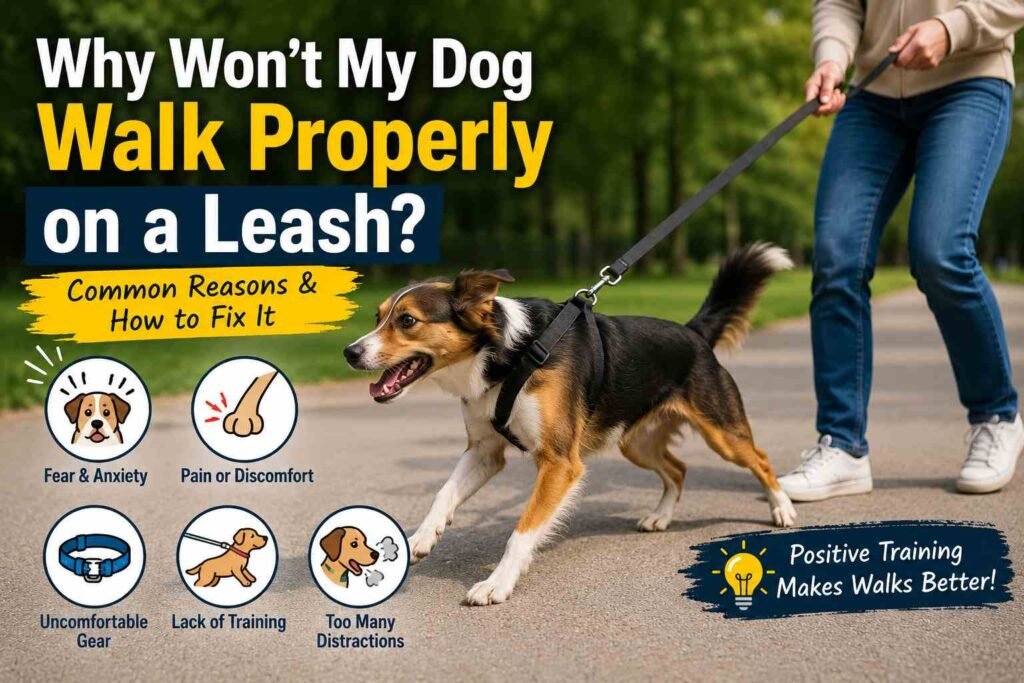
If you are dealing with loose leash training problems, remember that walking politely on a leash is a learned skill. Dogs naturally want to sniff, explore, investigate sounds, and move toward interesting things.
Your dog may pull ahead, stop to sniff, change direction, or refuse to move because it has never been taught how to walk calmly beside you.
The goal is not to make your dog walk rigidly at your side for the entire outing. Instead, teach your dog that staying near you and keeping some slack in the leash is rewarding.
Short training sessions are usually easier than expecting perfect behavior throughout a long walk. Reward your dog when it checks in with you, follows your direction, or walks calmly for several steps.
How to Fix Dog Stalling on Walks
The first step in learning how to fix dog stalling on walks is to stop guessing. Watch your dog carefully and identify when the stopping happens.
If your dog stops at the same location every time, something in that area may be triggering the behavior. If your dog stops whenever the leash becomes tight, equipment or leash training may be involved. If your dog stops randomly and appears uncomfortable, a health problem should be considered.
Start with short, easy walks in places where your dog feels comfortable. Reward forward movement with small treats, praise, or another reward your dog enjoys. Keep your voice relaxed and avoid turning the walk into a struggle.
It is also worth checking the collar or harness. Equipment that rubs, presses, or fits incorrectly can make walking unpleasant.
Do not drag your dog forward. If your dog is frightened, forcing it toward the trigger can increase anxiety. Instead, create distance and give your dog an opportunity to calm down.
How to Fix Loose-Leash Training Problems
For dogs with loose leash training problems, begin somewhere quiet rather than immediately practicing on a busy street.
Ask your dog to stay close and reward a few calm steps. When the leash remains loose, continue rewarding. If your dog pulls ahead, stop and wait for the leash to become loose again before continuing.
As your dog improves, slowly introduce more distractions. You can eventually practice around people, other dogs, traffic, and different environments, but do not increase difficulty too quickly.
Sniffing can also be part of a healthy walk. You do not need to prevent your dog from exploring every smell. Instead, teach your dog that calm walking and checking in with you are followed by opportunities to sniff.
If you need dog won’t walk on leash troubleshooting, remember that consistency matters more than speed. A few successful steps are better than a long walk filled with frustration.
What If My Puppy Stops Walking on a Leash?
A puppy stops walking on leash for many of the same reasons as an adult dog, but unfamiliarity is often a major factor.
The leash, harness, sidewalk, traffic, noises, and outdoor environment can all be completely new. A puppy may freeze simply because it is trying to understand what is happening.
Keep early walks short and positive. Allow your puppy to explore safe surroundings and reward calm behavior. Avoid rushing it through frightening experiences.
If your puppy becomes overwhelmed, moving to a quieter location can help. With patience and repeated positive experiences, most puppies gradually become more comfortable with walking.
Why Does My Dog Refuse to Walk in Certain Places?
A dog refuses to walk in certain places because it may associate that location with something unpleasant or frightening.
For example, your dog might dislike a particular intersection because of heavy traffic, avoid a slippery floor, or refuse to pass a house where another dog frequently barks.
Try changing the route and observing your dog’s reaction. If the dog immediately relaxes somewhere else, the environment may be the trigger.
Gradual exposure can help, but the goal should be to keep your dog below the point of overwhelming fear. Give it enough space to remain calm and reward relaxed behavior.
What Should You Do When Your Dog Refuses to Move Forward?
When your dog refuses to move forward on leash, stop and observe before doing anything else. Look at its body language and identify what it is watching, smelling, or reacting to.
If your dog is frightened, create distance from the trigger. If it appears distracted, calmly redirect its attention. If it seems tired or uncomfortable, consider ending the walk.
Avoid yelling, jerking the leash, or physically dragging your dog. These responses can damage trust and may make fear-based walking problems worse.
Sometimes the best decision is simply to turn around and try again another day.
When Should You Call a Veterinarian?
A veterinarian should be contacted when walking refusal is sudden, persistent, or accompanied by signs of physical discomfort.
Pay particular attention if your dog begins limping, shaking, struggling to stand, showing stiffness, crying, refusing normal activities, or behaving differently at home as well as outside.
A dog stopping constantly on walks is not always experiencing a training problem. Pain can change the way a dog moves and may make normal activities uncomfortable.
When there is a possibility of illness or injury, it is safer to rule out a medical cause before assuming the behavior is stubbornness.
When Should You Work With a Dog Trainer or Behaviorist?
If your dog’s main problem is pulling, stopping, or inconsistent leash behavior, a qualified reward-based trainer may be helpful.
More serious fear or anxiety may require a behavior professional. If your dog becomes extremely fearful, aggressive, or difficult to handle safely, talk with your veterinarian about the appropriate next step.
Training works best when it addresses the reason behind the behavior instead of simply trying to suppress it.
FAQs About Dogs Refusing to Walk
Why does my dog suddenly stop walking?
A dog may suddenly stop because of fear, a distraction, pain, unfamiliar surroundings, or discomfort with its leash or harness. A sudden change should be taken more seriously than a long-standing training issue.
Why does my dog stop and look around on walks?
Your dog may stop and look around because it hears a sound, smells something interesting, notices another animal, or feels uncertain about its surroundings. Watch its body language to determine whether it is curious or afraid.
Why does my dog refuse to walk down the street?
Your dog may refuse to walk down the street because of traffic, unfamiliar sounds, another dog, a previous frightening experience, or general anxiety about leaving a familiar area.
Should I pull my dog when it refuses to walk?
No. Pulling or dragging a frightened or uncomfortable dog can increase stress and make the problem harder to solve. First determine why your dog is refusing to move.
How do I get my dog to walk on a leash?
Start with short walks in quiet areas and reward your dog for calm movement and a loose leash. Gradually introduce distractions as your dog’s confidence improves.
Final Takeaway
When a dog refuses to walk, the behavior is usually telling you something. Your dog may be scared, uncomfortable, distracted, tired, inexperienced, or dealing with a physical problem.
The key is to understand the reason before trying to correct the behavior. Start with calm, short walks, use positive reinforcement, check the walking equipment, and avoid dragging your dog forward.
If the refusal is sudden or comes with shaking, limping, stiffness, pain, or other unusual symptoms, speak with a veterinarian. Once you know why your dog is stopping, freezing, planting its feet, or refusing to move, you can choose a solution that makes walks safer and more enjoyable for both of you.